# Gumloop 官方文档 — Agent Access(Owner / User 双角色 + 8 项 User Permissions)
> 来源:https://docs.gumloop.com/core-concepts/agent_access.md
> 抓取日期:2026-09-20(v10.30.0 Kyuquot / v11.0.0 Conche)
> 关联:v11.0.0 Agent Owners and Users(9/13 ✅ SPEC 候选 → spec_agent-owner-user-roles.md)
---
> ## Documentation Index
> Fetch the complete documentation index at: https://docs.gumloop.com/llms.txt
> Use this file to discover all available pages before exploring further.
# Agent Access
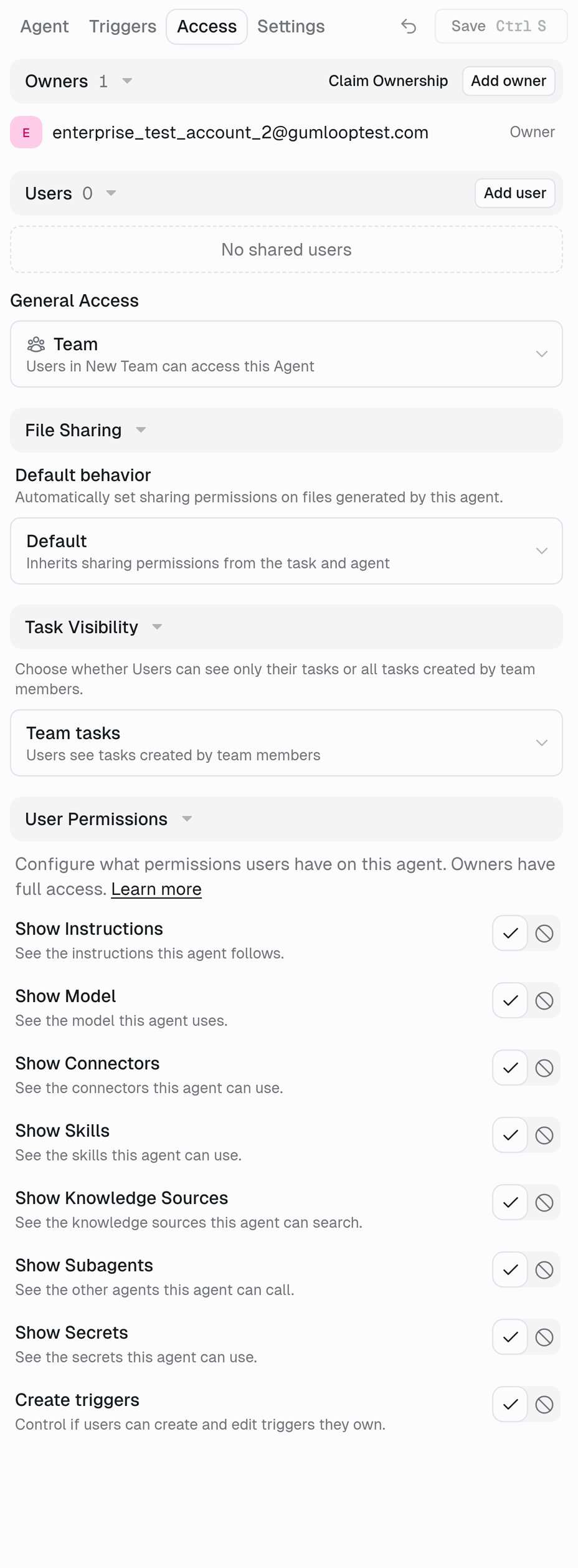
Agents have exactly **two roles**: **Owners** manage the agent, **Users** run it. Everything on this page is configured from the **Access** tab of the agent.
## Owner vs. User at a glance
| | Owner | User |
| ------------------------------------------------------------------------------- | :---: | :-----------------------------: |
| Run the agent and start tasks | ✅ | ✅ |
| See instructions, model, connectors, skills, knowledge, subagents, secret names | ✅ | Only what Owners choose to show |
| Edit any of the above | ✅ | ❌ |
| Create their own triggers | ✅ | Only if Owners allow it |
| Manage every trigger on the agent, including other people's | ✅ | ❌ |
| Add/remove Owners and Users, change General Access | ✅ | ❌ |
| Set User Permissions and Task Visibility | ✅ | ❌ |
| See every task on the agent | ✅ | Depends on Task Visibility |
| Delete the agent | ✅ | ❌ |
As an **Owner** you tune exactly what Users can see and what they can create on the agent — and you can add as many Owners as you like to share that control.
 ***
## Give someone access
Everyone below is added from the **Share** button at the top of the agent, which opens the **Share This Agent** modal. The same controls also live in the **Access** tab of the agent configuration.
**Share** → type their email in **Add people** → pick the role next to the **Share** button → **Share**.
* *Can manage this agent* = Owner
* *Can use this agent* = User
A direct email grant sticks: it keeps working even if General Access is lowered later.
Instead of adding people one by one, set **General Access** in the Share modal. Everyone who comes in this way is a **User** — there is no role picker.
***
## Give someone access
Everyone below is added from the **Share** button at the top of the agent, which opens the **Share This Agent** modal. The same controls also live in the **Access** tab of the agent configuration.
**Share** → type their email in **Add people** → pick the role next to the **Share** button → **Share**.
* *Can manage this agent* = Owner
* *Can use this agent* = User
A direct email grant sticks: it keeps working even if General Access is lowered later.
Instead of adding people one by one, set **General Access** in the Share modal. Everyone who comes in this way is a **User** — there is no role picker.
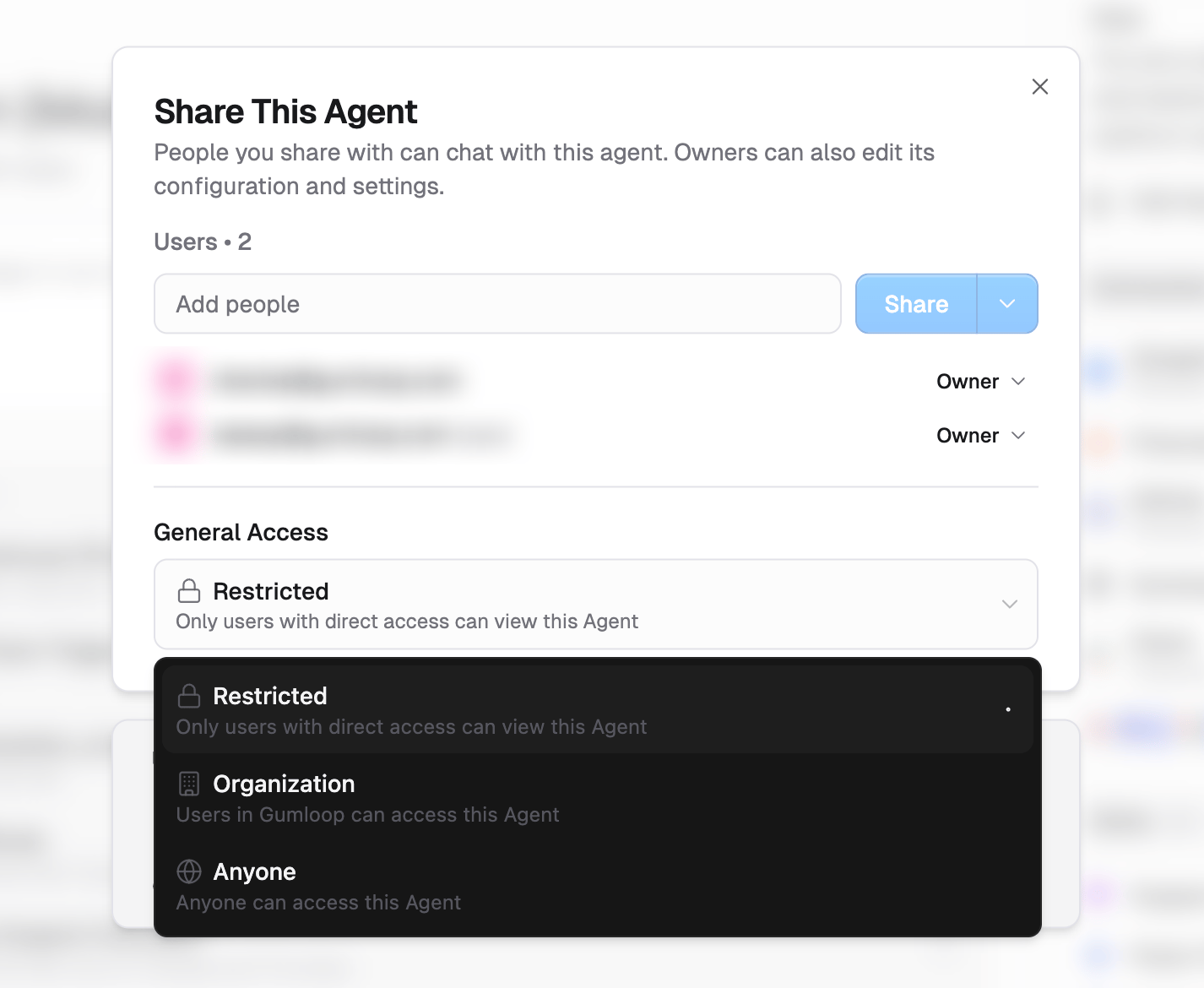 | Setting | Who can use the agent |
| ---------------- | ----------------------------------------------------------------- |
| **Restricted** | Only Owners and people added by email (personal agents only). |
| **Team** | Everyone in the team the agent lives in. |
| **Organization** | Everyone in your organization. |
| **Anyone** | Anyone with the link, including people without a Gumloop account. |
Agents that live in a team cannot be **Restricted** — Team is the floor.
Click the role dropdown next to a person in the Share modal (or the Access tab):
* **Promote to Owner** on a User
* **Demote to User** on an Owner
The last Owner cannot be demoted or removed. Add a second Owner first.
***
## User Permissions
Eight per-agent switches that control what **Users** see. Owners always see everything.
| Setting | Who can use the agent |
| ---------------- | ----------------------------------------------------------------- |
| **Restricted** | Only Owners and people added by email (personal agents only). |
| **Team** | Everyone in the team the agent lives in. |
| **Organization** | Everyone in your organization. |
| **Anyone** | Anyone with the link, including people without a Gumloop account. |
Agents that live in a team cannot be **Restricted** — Team is the floor.
Click the role dropdown next to a person in the Share modal (or the Access tab):
* **Promote to Owner** on a User
* **Demote to User** on an Owner
The last Owner cannot be demoted or removed. Add a second Owner first.
***
## User Permissions
Eight per-agent switches that control what **Users** see. Owners always see everything.
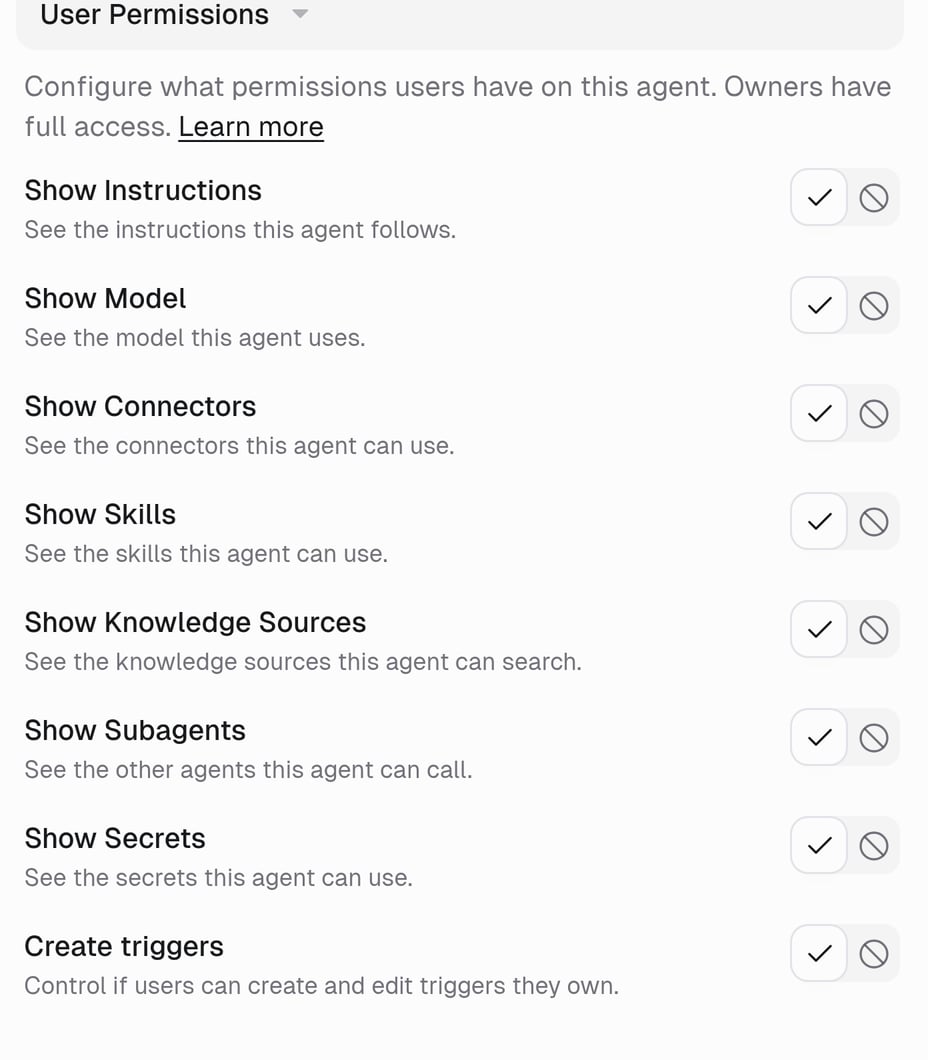 | Setting | Show means the User can |
| -------------------------- | ----------------------------------------------------------------- |
| **Show Instructions** | Read the instructions the agent follows (read-only). |
| **Show Model** | See which model the agent runs on. |
| **Show Connectors** | See the connected apps the agent can use. |
| **Show Skills** | See the skills the agent can use. |
| **Show Knowledge Sources** | See the knowledge sources the agent can search. |
| **Show Subagents** | See the other agents this agent can call. |
| **Show Secrets** | See the **names** of the secrets the agent can use. |
| **Create triggers** | Create and edit their own triggers (**Allow** / **Don't allow**). |
Three rules worth remembering:
* **Visible is not editable.** Showing the instructions lets a User read the prompt, never change it.
* **Hiding something does not disable it.** Hide Connectors and the agent still uses Gmail — the User just doesn't see it listed.
* **Permissions are per agent, not per person.** Everyone with User access gets the same view.
Out of the box every visibility setting is **Show** and **Create triggers** is **Allow**. Organization admins can ship different defaults with [Agent Default Settings](/enterprise-features/agent_default_settings).
If you switch **Create triggers** to **Don't allow** while Users already have triggers, Gumloop asks what to do:
* **Keep running** — they keep firing. Users cannot create, edit, or activate triggers, but can still view, deactivate, and delete their own.
* **Disable them** — they are switched off.
Owners can still manage those triggers from the **Triggers** tab. Allowing creation again does **not** reactivate disabled triggers.
**Example setup — an internal support agent everyone talks to:** General Access **Organization**, *Show Instructions* **Hide**, *Show Connectors* **Show**, *Create triggers* **Don't allow**.
***
## Task Visibility
A **task** is one conversation with the agent.
| Setting | Show means the User can |
| -------------------------- | ----------------------------------------------------------------- |
| **Show Instructions** | Read the instructions the agent follows (read-only). |
| **Show Model** | See which model the agent runs on. |
| **Show Connectors** | See the connected apps the agent can use. |
| **Show Skills** | See the skills the agent can use. |
| **Show Knowledge Sources** | See the knowledge sources the agent can search. |
| **Show Subagents** | See the other agents this agent can call. |
| **Show Secrets** | See the **names** of the secrets the agent can use. |
| **Create triggers** | Create and edit their own triggers (**Allow** / **Don't allow**). |
Three rules worth remembering:
* **Visible is not editable.** Showing the instructions lets a User read the prompt, never change it.
* **Hiding something does not disable it.** Hide Connectors and the agent still uses Gmail — the User just doesn't see it listed.
* **Permissions are per agent, not per person.** Everyone with User access gets the same view.
Out of the box every visibility setting is **Show** and **Create triggers** is **Allow**. Organization admins can ship different defaults with [Agent Default Settings](/enterprise-features/agent_default_settings).
If you switch **Create triggers** to **Don't allow** while Users already have triggers, Gumloop asks what to do:
* **Keep running** — they keep firing. Users cannot create, edit, or activate triggers, but can still view, deactivate, and delete their own.
* **Disable them** — they are switched off.
Owners can still manage those triggers from the **Triggers** tab. Allowing creation again does **not** reactivate disabled triggers.
**Example setup — an internal support agent everyone talks to:** General Access **Organization**, *Show Instructions* **Hide**, *Show Connectors* **Show**, *Create triggers* **Don't allow**.
***
## Task Visibility
A **task** is one conversation with the agent.
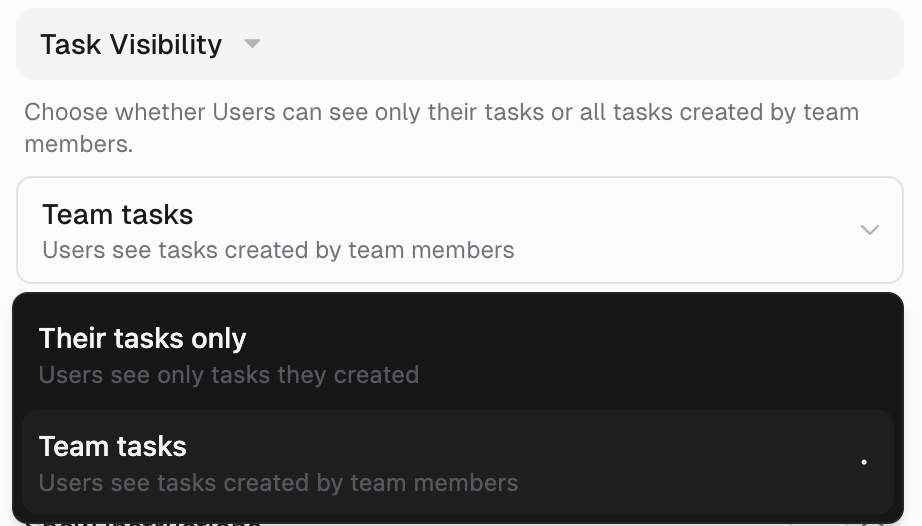 | Option | What Users see |
| -------------------- | ------------------------------------------------------------------------------------------------------------- |
| **Their tasks only** | Each User sees only the tasks they created. |
| **Team tasks** | Users can **read** tasks created by team members. Continuing someone else's task still requires Owner access. |
* This setting only exists on **team agents**, and new team agents default to **Team tasks**.
* On a personal agent, Users see only their own tasks, so the setting is hidden.
* Owners always see every task on either kind of agent, and any task can also be shared separately.
Seeing a task includes its task-linked artifacts. It never grants access to another person's private persistent workspace files.
***
## File Sharing
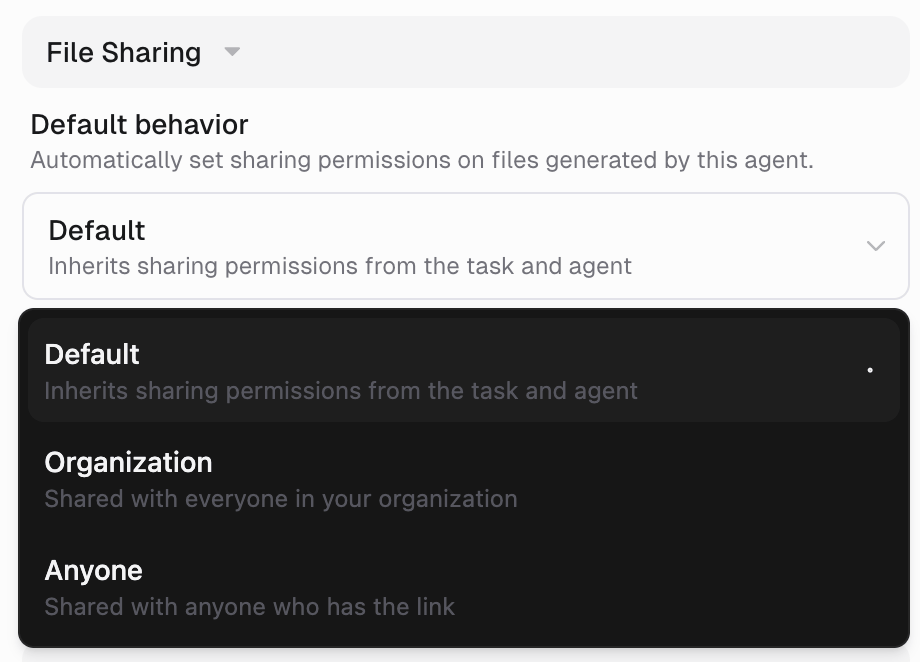
**Default behavior** sets sharing for every file the agent generates.
| Option | What Users see |
| -------------------- | ------------------------------------------------------------------------------------------------------------- |
| **Their tasks only** | Each User sees only the tasks they created. |
| **Team tasks** | Users can **read** tasks created by team members. Continuing someone else's task still requires Owner access. |
* This setting only exists on **team agents**, and new team agents default to **Team tasks**.
* On a personal agent, Users see only their own tasks, so the setting is hidden.
* Owners always see every task on either kind of agent, and any task can also be shared separately.
Seeing a task includes its task-linked artifacts. It never grants access to another person's private persistent workspace files.
***
## File Sharing
**Default behavior** sets sharing for every file the agent generates.
 | Option | Generated files are shared with |
| ---------------- | ----------------------------------------------------------------------------------------------- |
| **Default** | Whoever can see the task and the agent — a file created in a team task is visible to that team. |
| **Organization** | Everyone in your organization. |
| **Anyone** | Anyone with the link. |
See [Agent Artifacts](/core-concepts/agent_artifacts).
***
## Requesting and claiming access
A User who needs to manage the agent opens the **⋮** menu in the agent header and chooses **Request Owner access**, then picks which Owner receives it. That Owner approves or denies it from their inbox. See [Request Owner Access](/help/sharing/request-owner-access).
If an agent's Owners are unavailable, an organization admin in the same organization can manage it through administrative access and claim durable ownership. Claiming does not require every existing Owner to be gone: it changes the canonical creator and adds an Owner grant, and existing Owners remain. See [Claim an ownerless agent](/help/sharing/claim-an-ownerless-agent).
Organization admins can reach any agent in the organization through their admin override, even without a grant. Admin access is **not** the same as being an Owner — that's why **Claim Ownership** exists.
***
## FAQ
They no longer apply to agents. An editor becomes an **Owner**; a viewer or use-only person becomes a **User** whose visibility you tune with User Permissions. Skills still use Editor, Viewer, and Use Only. See [Sharing a skill](/core-concepts/skills#sharing-a-skill).
No. Every User Permission is about seeing, not editing. Editing the agent requires Owner.
Not today. User Permissions are per agent, not per person. If one person needs more, make them an Owner, or make a copy of the agent with different settings.
An agent always needs someone who can manage it. Add a second Owner first, then demote or remove the original.
An organization admin can open it and use **Claim Ownership** to take it over.
***
## Related
The agent builder, tab by tab.
Who can create triggers, and what happens when you turn that off.
Quick answer with the eight settings.
Owner vs User, and roles on skills.
| Option | Generated files are shared with |
| ---------------- | ----------------------------------------------------------------------------------------------- |
| **Default** | Whoever can see the task and the agent — a file created in a team task is visible to that team. |
| **Organization** | Everyone in your organization. |
| **Anyone** | Anyone with the link. |
See [Agent Artifacts](/core-concepts/agent_artifacts).
***
## Requesting and claiming access
A User who needs to manage the agent opens the **⋮** menu in the agent header and chooses **Request Owner access**, then picks which Owner receives it. That Owner approves or denies it from their inbox. See [Request Owner Access](/help/sharing/request-owner-access).
If an agent's Owners are unavailable, an organization admin in the same organization can manage it through administrative access and claim durable ownership. Claiming does not require every existing Owner to be gone: it changes the canonical creator and adds an Owner grant, and existing Owners remain. See [Claim an ownerless agent](/help/sharing/claim-an-ownerless-agent).
Organization admins can reach any agent in the organization through their admin override, even without a grant. Admin access is **not** the same as being an Owner — that's why **Claim Ownership** exists.
***
## FAQ
They no longer apply to agents. An editor becomes an **Owner**; a viewer or use-only person becomes a **User** whose visibility you tune with User Permissions. Skills still use Editor, Viewer, and Use Only. See [Sharing a skill](/core-concepts/skills#sharing-a-skill).
No. Every User Permission is about seeing, not editing. Editing the agent requires Owner.
Not today. User Permissions are per agent, not per person. If one person needs more, make them an Owner, or make a copy of the agent with different settings.
An agent always needs someone who can manage it. Add a second Owner first, then demote or remove the original.
An organization admin can open it and use **Claim Ownership** to take it over.
***
## Related
The agent builder, tab by tab.
Who can create triggers, and what happens when you turn that off.
Quick answer with the eight settings.
Owner vs User, and roles on skills.